

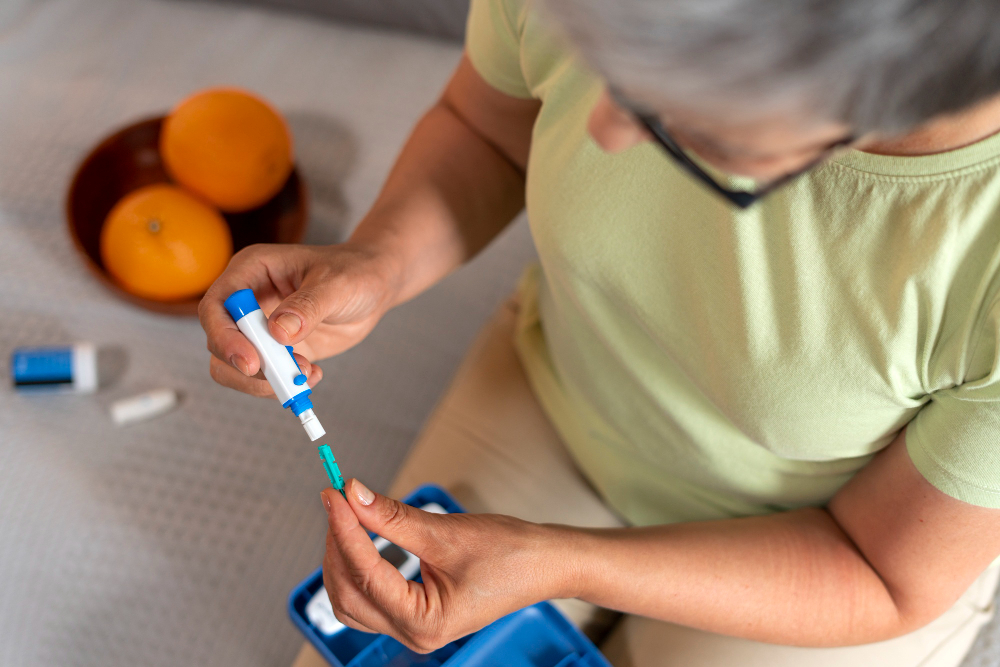
At Clare Senior Care, we know that daily blood sugar checks are a vital part of life for many of our AFC and GAFC residents. However, those daily finger-pricks only tell you what is happening right now. To truly understand how your body is handling sugar over the long term, doctors use a powerful tool called the A1C Test.
If your doctor has recently ordered this test, or if you’re wondering why it’s scheduled every few months, here is everything you need to know about the A1C and why it matters for your health journey.
What Exactly is an A1C Test?
Think of your daily blood sugar checks as a “snapshot” and the A1C test as a “movie.” While a snapshot shows one moment, the A1C measures your average blood sugar levels over the past 3 months.
The Science Made Simple:
When sugar enters your blood, it attaches to a protein in your red blood cells called hemoglobin. Since red blood cells live for about three months before being replaced, the A1C test can “see” how much sugar has been coating those cells over their entire lifespan.
Understanding the Results
When you get your results back from the lab, they will be expressed as a percentage. Here is the general breakdown of what those numbers mean:
| A1C Level | What it Means |
| Below 5.7% | Normal |
| 5.7% to 6.4% | Prediabetes |
| 6.5% or Above | Diabetes |
For those already living with diabetes, the goal is typically to keep your A1C at 7% or less. Keeping your number in this range is one of the best ways to prevent long-term health complications.
If you are already living with diabetes, your A1C percentage corresponds to an estimated average glucose level in mg/dL. This helps you compare your long-term average to your daily home readings.
| A1C Percentage (%) | Estimated Average Glucose (mg/dL) |
| 6% | 126 |
| 7% | 154 |
| 8% | 183 |
| 9% | 212 |
| 10% | 240 |
| 11% | 269 |
| 12% | 298 |
A1C vs. Daily Monitoring: Why You Need Both
It’s important to remember that the A1C test does not replace your daily home monitoring.
- Daily checks help you make immediate decisions about food, exercise, and insulin.
- The A1C test helps your doctor decide if your overall treatment plan is working or if your medications need a “tune-up.”
What to Expect at the Appointment
The A1C test is a simple blood draw performed at a lab or your doctor’s office.
- No Fasting Required: Unlike many other blood tests, you can eat and drink normally before an A1C test.
- Frequency: If you have diabetes, you’ll likely get this test at least twice a year. If your results show prediabetes, your doctor may check it every 1 to 2 years to monitor for changes.
Factors That Can Affect Your Score
Sometimes, other health conditions can make your A1C results appear higher or lower than they actually are. Be sure to tell your doctor if you have:
- Severe anemia or blood disorders (like sickle cell).
- Kidney or liver disease.
- Had a recent blood transfusion.
- Certain medications, such as opioids.
How Clare Senior Care Supports You
Managing prediabetes or diabetes can feel like a full-time job. Whether it’s coordinating transportation to your lab appointments or helping you maintain a healthy lifestyle to lower your A1C, the team at Clare Senior Care is here to support you.
With the right information and a dedicated care team, reaching your health goals is entirely possible!
Disclaimer & Source
Medical Disclaimer: This content is for informational purposes only and does not constitute medical advice. Always consult with your healthcare provider to determine your specific A1C goals and testing schedule.
Source: Information adapted from the Centers for Disease Control and Prevention (CDC):All About the A1C Test.
